


A researcher needs to simulate protein folding. She logs into a terminal, not to use one machine, but to tap into a sprawling network that handles the load. A trader needs to predict stock movements. He pulls up data on a handheld PDA, pulling power from his company’s backend infrastructure. A military commander is coordinating a strike. He doesn’t rely on a single server farm; he accesses resources across three distinct, segregated military networks to formulate a strategy.
These scenarios sound like science fiction or enterprise-level fantasy, but they all point to the same underlying architecture: grid computing.
It is the digital equivalent of pooling resources. In a grid, you don’t just have your own computer’s power. You have access to the processing cores, memory, and storage of every authorized machine in the system. It’s distributed computing on steroids. The goal? To make a network of disparate computers act like one massive, unified supercomputer.
The Myth of the Single Machine
Historically, if you needed more power, you bought a faster computer. You added more RAM. You slapped on a bigger hard drive. There was a ceiling to what a single box could do, no matter how much money you threw at it. Grid computing shatters that ceiling.
Think of it like a camping trip. You are going solo. You have one tent. Your friend has another. One brings the food. One brings the SUV. If you go alone, you have to carry everything. You are limited by your own strength and your own gear. If you travel together, you share the load. You use each other’s skills. The trip becomes easier, faster, and more efficient because no single person is carrying the entire burden.
Grid computing applies this logic to data.
A standard computer relies on its own Central Processing Unit (CPU). This microprocessor crunches numbers and directs data. It also relies on memory (RAM), which is temporary high-speed storage close to the CPU, and storage (hard drives or databases), which is permanent but slower. By default, a user is trapped within the limits of their own hardware.
In a grid, those limits vanish. The system links these resources together. When you run a query, the grid doesn’t just use your CPU. It routes parts of the task to thousands of other machines in the network. To the user, it feels like magic. You are accessing the collective power of the entire grid, not just the silicon in front of you.
It’s Not New, But It’s Not Ready
Here is the catch: grid computing isn’t a new idea. It is a specific type of distributed computing. Distributed computing has existed for decades, with different computers sharing resources over a network. But true grid computing takes it further. In the ideal state, every resource is shared. Every processor cycle and every byte of storage becomes a community asset.
Accessing it should be seamless. The interface shouldn’t look like you are hacking into a mainframe. It should look like you are working on your own desktop. The difference is the invisible scale of the horsepower behind the scenes.
However, the technology is far from perfected. We are still in the messy middle. Computer scientists and engineers are currently wrestling with standards and protocols. Right now, many grid systems rely on proprietary software. They are siloed. If you want to join the grid, you often need specific, vendor-locked tools. Until the industry agrees on a universal set of rules, adoption is clunky. Organizations hesitate to invest in infrastructure that might not play nicely with others.
The Jargon Trap
If you dive into grid computing documentation, you will drown in acronyms. The field borrows heavily from other tech sectors. To understand how it works, you need to separate the signal from the noise.
Grid computing is related to several other models, and the lines are often blurred:
- Shared Computing: This is the broad category. It refers to any collection of computers sharing processing power to complete a task. It’s a bit generic.
- Utility Computing: This is often delivered via Software-as-a-Service (SaaS). Think of it like electricity. You don’t build a power plant; you plug into the grid and pay for what you use. Companies offer storage or processing power on a metered basis.
- Cloud Computing: This is the most familiar term today. In cloud computing, applications and storage “live” on the web. You don’t own the hardware; you rent access to it. While cloud and grid share roots, grid focuses more on the pooling of idle resources for massive computational tasks, while cloud often focuses on delivering services over the internet.
To navigate these concepts, you need to know the lexicon. Here are the basics:
- Cluster: A group of networked computers that share resources. They work together as a single unit.
- Node: Any device on a network that can transmit, receive, or reroute data. Control nodes manage the flow.
- XML (Extensible Markup Language): A coding language that describes data. It is human-readable and machine-readable. Control nodes use XML derivatives like WSDL (Web Services Description Language) to understand how to handle specific applications and data types.
- Hub: A central point in a network where multiple devices connect.
- IDE (Integrated Development Environment): The toolkit programmers use to build applications.
- Sandbox: An isolated environment used for testing applications without risking the main system.
The technology works. The concept is sound. But the fragmentation of standards remains the biggest hurdle. Until the “plumbing” of the grid is standardized, we will continue to see isolated islands of power rather than a truly unified global supercomputer.
The Technical Vocabulary
To understand grid computing, you have to speak the language. It’s not just buzzwords; it’s the mechanics of how disparate machines talk to each other.
Interoperability is the bedrock. Without it, your PC and a Macintosh are islands. They have different operating systems, different architectures. They can’t work together unless the software bridges that gap.
Then there are open standards. Proprietary standards lock you into a single vendor’s ecosystem. Open standards are public. Anyone can adopt them. This makes integration far easier because everyone is playing by the same rulebook.
We’re also talking about parallel processing. This isn’t just multitasking on one chip. It’s using multiple CPUs to solve a single computational problem. It’s closely tied to shared computing, which siphons untapped resources from a network to get the job done.
A platform is just the foundation. It could be an OS, an architecture, a language, or even a website. Developers build on top of it.
When one server isn’t enough, you need a server farm. A cluster of servers working together on tasks too complex for a single machine.
But buying more hardware is expensive. Enter server virtualization. This technique uses software to slice a single physical server into multiple exclusive virtual platforms. Each virtual server runs its own OS independently. One box can host a Linux server and a Windows server simultaneously. This works because most servers sit idle most of the time. Virtualization cuts hardware costs for grid systems that need dozens of nodes.
In this environment, a service is any software system allowing computers to interact over the network.
Communication often relies on SOAP (Simple Object Access Protocol). A set of rules for exchanging XML messages across a network. Microsoft developed it. It’s the syntax for the conversation.
Data management brings us to state. In IT, state is any persistent data. It survives the application’s lifecycle. When you drop books into an Amazon cart, that’s stateful data. Amazon tracks your selection as you browse. Stateful services enable multi-step apps that rely on consistent core data.
And finally, transience. The ability to turn a service on or off across the network without crashing the whole operation.
Sharing Resources
So, how do these pieces link up?
Several organizations are racing to create standardized protocols. The goal? Make grid computing environments plug-and-play.
Grid systems exist today. But compatibility is hit-or-miss. Why? Because each system often uses a unique set of protocols and tools. Two grids might not talk to each other. That lack of agreement is the bottleneck.
A functional grid computing system generally requires three things:
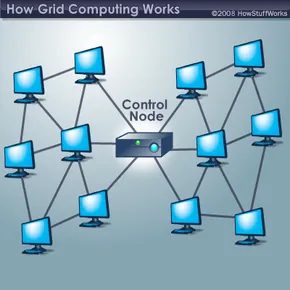
- A Control Node. Usually a server handling administrative duties. It’s the dispatcher.
- A Network. Computers running special grid software. These act as user interfaces and resource pools. The network can be homogeneous (same OS, same hardware) or heterogeneous (a hodgepodge of everything). It can be hardwired or over the open Internet.
- Middleware. The workhorse. Software that allows different computers to run a process across the network. Without middleware, communication is impossible. There’s no single format for middleware, which adds to the fragmentation problem.
The control node is busy. It prioritizes tasks. It schedules work across the network. It decides which resources each task gets. It monitors for overload. Crucially, it must ensure the user’s local machine doesn’t slow down. The grid should tap into unused resources. If your computer lags when the grid runs, the system is failing.
The Standardization Problem
The potential is limitless. But only if everyone agrees on protocols and tools.
Without a standard format, third-party developers are stuck. Independent programmers want to build apps on the grid, but they can’t guarantee compatibility. They might have to build different versions of the same app for different systems. That’s time-consuming. Developers don’t want to do the same work twice.
A standardized protocol set would let developers focus on one format. One codebase. One grid.
Until then, we’re stuck with a fragmented landscape. Powerful, yes. But messy.
Which brings us back to the question: if the hardware is there, and the software exists, why isn’t every network a grid?
The Security Paradox of Distributed Power
Linking disparate machines into a single computational fabric sounds like a utopian solution for processing power. It isn’t. It’s a logistical headache wrapped in security risks. When you connect two computers, let alone thousands, you invite questions about privacy, access control, and resource hogging.
Middleware is the answer, or at least the current bandage. Grid protocols don’t inherently solve these problems; they just make it easier for developers to build the tools that do. The big concern? Encryption.
Most engineers rely on encryption to keep data safe. You encode information so only those with the key can read it. Breaking that code usually requires factoring huge numbers into their prime divisors—a task that takes a normal supercomputer years. But here is the irony: a grid computing system can be weaponized to crack these very codes. If enough idle processors are linked, the time required to break strong encryption drops from years to days.
“A hacker could conceivably create a grid computing system for the purpose of cracking encrypted information.”
Proprietary software might offer a slight shield, but open standards—essential for grids to function—leave doors wide open. Every node needs specific software to interact with the whole. If that software has a vulnerability, the whole grid bleeds.
Then there’s the issue of access. You can’t just let everyone run wild. If a user ties up all the resources, you hit a deadlock. The control node freezes. Nothing happens. So, authorization and authentication protocols become non-negotiable. Only select users get full network access. Everyone else? They get their own machine back, minus the extra horsepower.
Who’s Watching the Storefront?
The middleware and the control node act as the bouncers of the grid. They manage the flow. They ensure no single computer dominates the network, and conversely, they ensure the network doesn’t strip-mine a user’s personal computer for every last drop of CPU cycles. If the system robs you of your own computing resources, it’s not efficient. It’s hostile.
From Science Fiction to Laboratory Bench
So, where is this power actually going? Not into your video games. Not into your spreadsheets.
Most operational grids today belong to academia and research. They are technically “shared computing systems” rather than true, persistent enterprise grids. They harvest unused cycles. And they are doing some heavy lifting.
SETI@home: Listening to the Void
The Search for Extraterrestrial Intelligence (SETI) project put grid computing on the map. Radio telescopes gather terabytes of cosmic noise. A single computer can’t sift through that haystack for a needle. SETI@home created a program that turns millions of home PCs into a virtual supercomputer. You install it. It sits in the background. It analyzes data for alien signals. If you want to play Call of Duty, the software yields. When you log off, it resumes.
Folding@home: Solving the Protein Puzzle
Then there is the Pande Group at Stanford. They aren’t looking for aliens; they’re looking for the causes of Parkinson’s and Alzheimer’s. The key is protein folding. Proteins take specific shapes to function. When they misfold, diseases follow.
Folding@home simulates how proteins fold. It’s a massive computational problem. The Pande Group hopes that by understanding the physics of misfolding, they can find new treatments. The process is identical to SETI: download the app, let your CPU idle during the night, and contribute to medical science.
The Ephemeral Nature of Volunteer Computing
There are dozens of these projects. Many are not permanent. Once the research goal is met, the grid dissolves. Sometimes a new project replaces the old one. Sometimes it just vanishes.
It’s a fascinating model. You lend your idle cycles to science. You get nothing back but the warm fuzzy feeling of contributing to SETI or medical research. The software is designed with low priority. It respects your machine. It shuts down when you need it. It wakes up when you don’t.
But does it matter? If the grid can be used to crack encryption, if the access controls are fragile, if the projects are temporary… is it worth the risk? The code is out there. The processors are online. The question is whether we’re building a tool for discovery or a botnet waiting to happen.
Once your computer finishes crunching the numbers, the project software pushes that data back to the control node. The node sorts it and shoves the results into the correct database. Then, it sends a fresh chunk of data to your machine. The cycle repeats until the job is done. If you have enough people participating, ambitious goals get crushed in a surprisingly short time.
As these grid computing systems get smarter, we will see more organizations building versatile networks. There might even come a day when corporations internetwork with each other directly. In that world, computational problems that seem impossible today could shrink down to a few hours of processing time. We will just have to wait and see.
Real-World Success: The Genome Comparison Project
Theory is fine, but results are better. Take the Genome Comparison Project as proof. This research effort aimed to compare protein sequences across more than 3,500 organisms. It kicked off on December 20, 2006.
By July 21, 2007, the project had already hit all its targets. It didn’t need a single supercomputer farm. It used a grid computing system to power through the heavy lifting. That is the power of distributed resources.
What Exactly Is Grid Computing?
People often confuse this with standard cloud computing. The difference lies in scope and purpose. A grid is a network of computers that share resources to solve large, complex problems. It acts like a virtual supercomputer.
You can think of grid computing as harnessing resources from multiple administrative domains to solve one single problem. It combines the power of many individual computers spread across a network, often the public Internet. This makes it distinct from a simple cluster, which usually stays within one organization.
Popular Examples of Grid Projects
Why does this matter to you? Because these networks are solving real-world crises. Here are a few notable examples:
- SETI@home : Uses spare processing power from millions of personal computers to search for extraterrestrial life. It turns idle CPUs into deep-space listening posts.
- Folding@home : Focuses on protein folding. By studying how proteins fold, researchers hope to better understand diseases like Alzheimer’s and Parkinson’s.
- World Community Grid : Tackles humanitarian challenges. This includes cancer research, HIV/AIDS studies, and clean energy initiatives.
These projects show how grid computing transforms idle hardware into a force for scientific good. You don’t need to be a scientist to help. You just need an internet connection and a bit of spare time.
Why This Matters Now
The sophistication of these systems is increasing. More corporations are likely to create versatile networks soon. We are moving toward an era where computational problems are reduced to manageable chunks. This democratizes high-performance computing. It means you don’t need a million-dollar server room to run simulations.
The infrastructure is already there. The Globus Alliance and the Open Grid Forum continue to refine the standards. Companies like IBM have long been invested in making grid computing accessible. The tools are easing internet collaboration for these massive tasks.
Looking Ahead
The next time you see your computer sitting idle, remember it could be part of something bigger. It could be analyzing protein sequences or scanning the stars. The technology is mature. The applications are growing. And the impact is real.
“Grid computing expands its reach.”
The pieces are in place. The question is whether we will use them fast enough. The future of distributed work is not coming. It is already here, running in the background of our daily lives.


