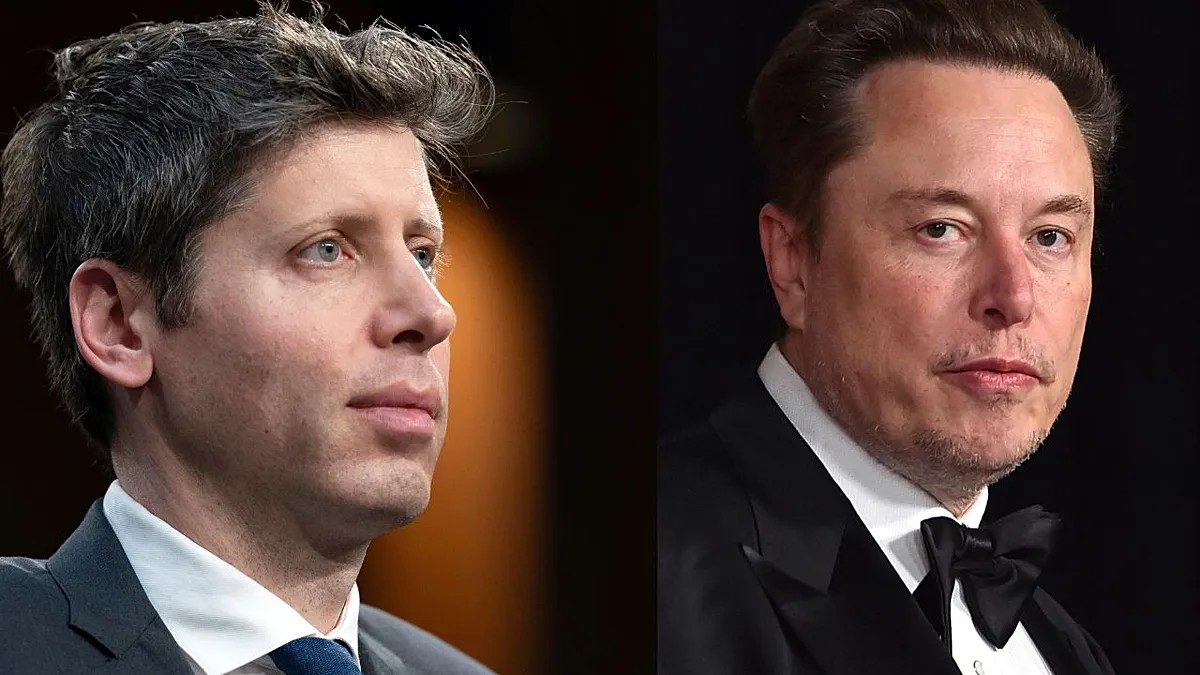
A high-stakes legal showdown is set to begin this Monday at the US District Court for the Northern District of California. The trial pits billionaire Elon Musk against Sam Altman, CEO of OpenAI, along with OpenAI President Greg Brockman and tech giant Microsoft.
At its core, this is not just a dispute between two powerful men; it is a fundamental legal battle over the original mission of artificial intelligence development: Is AI a public good meant for all humanity, or a proprietary product meant for profit?
The Core of the Dispute: Mission vs. Profit
The conflict stems from the very foundation of OpenAI. Founded in 2015 by Musk, Altman, and others, the organization was established as a nonprofit entity. Its primary mandate was to develop artificial intelligence that would benefit humanity, with a specific requirement that its breakthroughs remain “freely available to the public.”
Musk, who was the company’s largest early individual donor (contributing over $44 million), alleges that the company has fundamentally betrayed this founding charter. His lawsuit claims:
- The Shift to Profit: OpenAI has transitioned from a nonprofit mission to a for-profit enterprise, currently valued at nearly $1 trillion.
- The Microsoft Alliance: Musk argues that OpenAI’s multibillion-dollar partnership with Microsoft—which includes a $13 billion investment—has effectively turned OpenAI into a “closed-source de facto subsidiary” of Microsoft.
- Breach of Contract: The lawsuit contends that by partnering with a commercial giant, OpenAI has abandoned its promise to keep its technology open and accessible.
Context: A History of Friction
This trial is the culmination of years of tension between the two leaders. While Musk was an early supporter, his relationship with OpenAI fractured long before the current legal battle:
- 2018 Departure: Musk left the OpenAI board following disagreements regarding the company’s direction.
- Control Struggles: Reports suggest Musk attempted to gain greater control over the company in 2017, an effort that was unsuccessful.
- The ChatGPT Explosion: Following the 2022 launch of ChatGPT, OpenAI’s influence skyrocketed, leading to its massive valuation and its eventual restructuring into a for-profit model in 2025.
The Defense: Musk’s Previous Support
OpenAI has prepared a defense centered on Musk’s own past actions. In 2024, the company released a series of internal emails suggesting that Musk was not merely a passive observer of the company’s evolution, but an active participant.
According to OpenAI, these documents show that Musk previously supported the transition to a for-profit structure. Furthermore, the emails suggest Musk had his own ambitions for the company, including desires to lead the organization, maintain board control, and eventually merge OpenAI with Tesla.
What to Expect from the Trial
The proceedings, overseen by Judge Yvonne Gonzalez Rogers in Oakland, are expected to last between two and three weeks. The witness list is a “who’s who” of the tech industry, with the following figures expected to take the stand:
- Elon Musk (Tesla/xAI founder)
- Sam Altman (OpenAI CEO)
- Satya Nadella (Microsoft CEO)
This trial will likely set a critical precedent for how “nonprofit” mandates are interpreted in the age of hyper-commercialized technology.
Conclusion
The verdict in this case will do more than decide a legal contract; it will help define the future of AI governance. The court must determine whether OpenAI’s pivot to a commercial model constitutes a legitimate evolution or a breach of the foundational promise that AI should belong to the world, not a corporation.