Tensor Auto is making a bold statement with its Robocar, a fully autonomous vehicle designed from the ground up rather than retrofitted onto existing models. The company’s confidence was palpable during a pre-CES 2026 preview, where the vehicle was showcased as a premium, privately owned solution for Level 4 driving.
A Purpose-Built Approach to Self-Driving
Unlike companies like Waymo, which adapt existing cars for autonomous operation, Tensor has prioritized self-driving as the core design principle. According to Amy Luca, Tensor’s chief marketing officer, this difference is crucial: “This wasn’t built by taking an existing car and adding autonomy; it was designed as an autonomous vehicle first, and then designed to be something you’d actually want to own.”
This approach allows for tighter integration of sensors, processing power, and the user experience. The Robocar is conceived as an “agentic” vehicle—one that anticipates needs, communicates proactively, and operates based on real-time context, not just pre-programmed routes. Tensor’s experience in robotaxi development informed this design, but with private ownership as the ultimate goal.
Design and Hardware
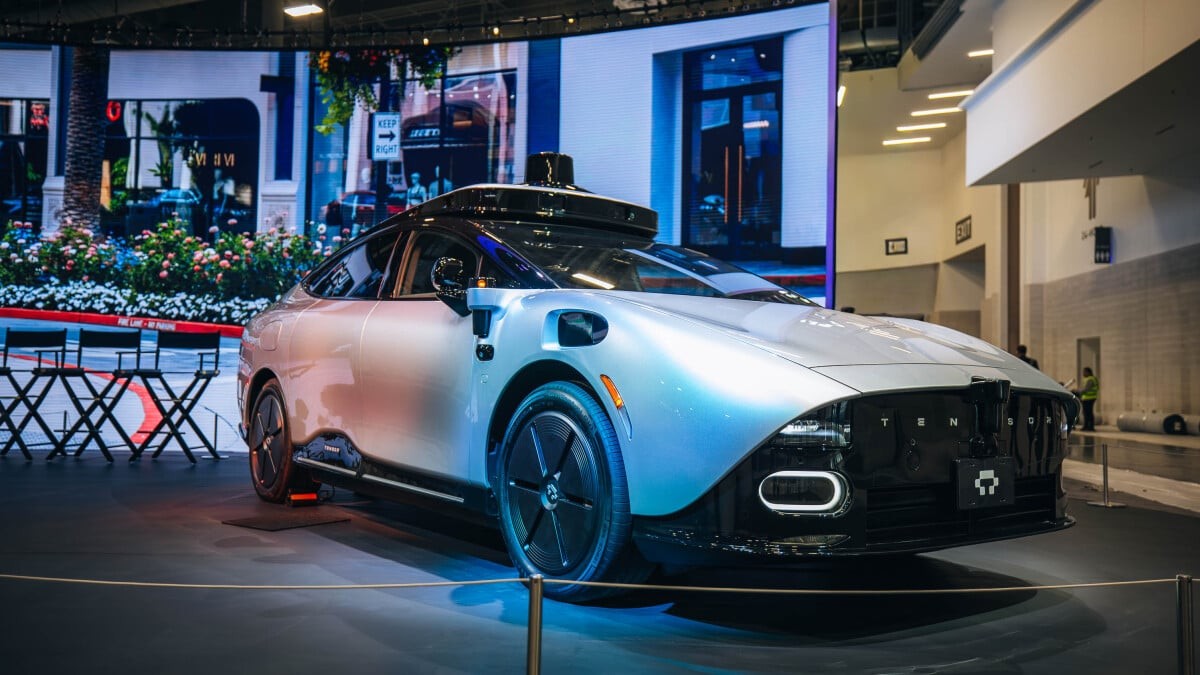
The Robocar’s exterior presents a sleek, silver sedan profile with aerodynamic lines. A prominent halo LiDAR unit dominates the roof, complemented by camera-based side mirrors, flush lighting, and subtle black accents. The vehicle is equipped with over 100 sensors, including five LiDAR units, more than a dozen cameras, and radar systems.
Tensor opted for an onboard Nvidia GPU and an internal hard drive to process this data, citing both performance and privacy as key considerations. This decision reflects a growing trend toward edge computing in autonomous vehicles, reducing reliance on cloud connectivity.
Interior and User Experience
The interior is designed to accommodate both manual and fully autonomous driving. The Robocar features a foldable steering wheel developed in partnership with Autoliv—the world’s first of its kind—that retracts entirely in autonomous mode, maximizing cabin space. This flexibility ensures that drivers retain the option to take control when desired.
Beyond functionality, the interior is positioned as a luxury experience with massage seats, a Dolby Atmos sound system, and spacious cabin layouts. Tensor acknowledges that the Robocar will be priced at the high end of the market, reflecting its advanced hardware and long-term autonomy roadmap.
Production and Outlook
Production is slated to begin in the second half of 2026. The overall impression is that the Robocar is a polished, finished product, signaling Tensor’s serious intent to compete in the emerging autonomous vehicle market.
Tensor’s Robocar isn’t just another self-driving car; it’s a statement about how autonomous technology can be integrated into a luxury experience. The company’s focus on purpose-built design and onboard processing suggests a long-term commitment to privacy, performance, and user control.