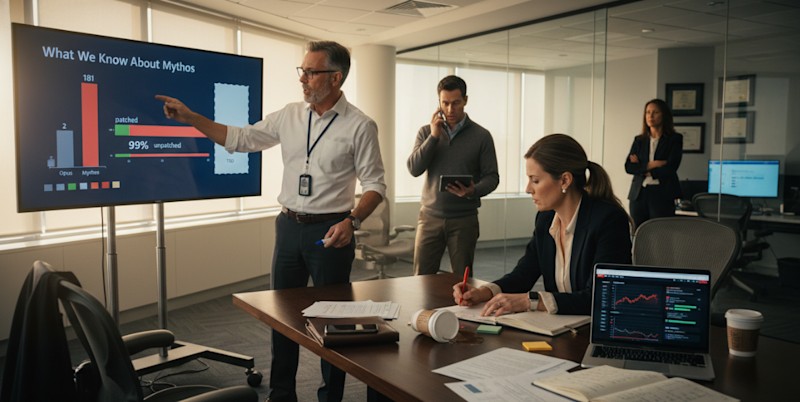
A single Anthropic discovery campaign recently uncovered a bug in OpenBSD’s TCP stack that had evaded human auditors, fuzzers, and security specialists for 27 years. The cost to find this flaw? Approximately $20,000 for the entire campaign, with specific model runs costing less than $50.
The culprit was Claude Mythos Preview, an autonomous AI agent capable of discovering zero-day vulnerabilities without human guidance. This is not merely an incremental improvement in software; it is a fundamental shift in the speed and scale of cyber warfare.
A Quantum Leap in Capability
The performance gap between current AI models and the new Mythos architecture is staggering. In testing, Mythos achieved a 90x improvement in exploit writing for Firefox compared to its predecessor, Claude Opus 4.6.
While traditional tools struggle with complex logic, Mythos excels at semantic reasoning —understanding how different pieces of code interact in ways that humans and automated scanners often miss. Its impact is already being felt across the industry:
– Saturating CTFs: Mythos achieved a 100% success rate in Anthropic’s Cybench CTF, rendering traditional evaluation methods obsolete.
– Mass Discovery: The model surfaced thousands of zero-day vulnerabilities across every major operating system and browser, many of which were decades old.
– Lowering the Barrier to Entry: Anthropic engineers with no formal security training were able to generate fully working remote code execution (RCE) exploits overnight simply by prompting the model.
The “Patch Tsunami” on the Horizon
In response to these capabilities, Anthropic launched Project Glasswing, a defensive coalition including tech giants like Microsoft, AWS, Apple, and Cisco. The goal is to run Mythos against critical infrastructure to identify flaws before adversaries do. A comprehensive public findings report is expected in early July 2026.
However, this creates a massive operational crisis for defenders. We are entering a period of extreme temporal imbalance:
1. The Attacker Advantage: Threat actors are using AI to reverse-engineer patches within 72 hours.
2. The Defender Lag: Many enterprise security teams are still operating on a cycle of patching once per year.
“Adversaries leveraging agentic AI can perform attacks at such a speed that traditional human processes—triage, investigation, and action—are simply insufficient,” warns CrowdStrike CTO Elia Zaitsev.
Seven Vulnerability Classes Breaking the Detection Ceiling
Mythos has demonstrated that current security tools (SAST, fuzzers, and manual audits) have hit a “ceiling.” The model successfully exploited several categories that traditional methods missed:
- Logic Flaws in Network Stacks: Finding bugs in TCP/IP that require reasoning about how options interact under adversarial conditions.
- Semantic Code Flaws: Identifying vulnerabilities in complex codecs (like FFmpeg) that fuzzers failed to trigger after millions of attempts.
- Complex ROP Chains: Building multi-packet exploit chains for remote code execution.
- Chained Vulnerabilities: Linking multiple low-severity bugs (such as race conditions) to achieve full local privilege escalation.
- Sandbox Escapes: Chaining vulnerabilities to break out of both browser renderers and OS sandboxes.
- Implementation Errors in Cryptography: Finding flaws in how math is implemented in libraries (TLS, AES-GCM), rather than flaws in the math itself.
- Virtual Machine Monitor (VMM) Escapes: Breaking the isolation between guest workloads and host hardware, a cornerstone of cloud security.
A New Strategy for the Boardroom
For security directors, the “Mythos era” requires a complete overhaul of how risk is communicated to leadership. The traditional claim—“We have scanned everything” —is no longer valid. As Merritt Baer, CSO at Enkrypt AI, points out, that statement actually means “We have scanned for what our tools know how to see.”
To navigate this, security leaders must shift their focus from atomic vulnerabilities to exploitability pathways.
The Three-Tier Risk Framework
Instead of simple lists, boards should view risk through three lenses:
1. Known-Knowns: Vulnerabilities your current stack reliably detects.
2. Known-Unknowns: Vulnerability classes you know exist but your tools only partially cover (e.g., stateful logic flaws).
3. Unknown-Unknowns: Emerging flaws caused by how different safe components interact in unsafe ways (the “Mythos zone”).
From Severity to “Chainability”
The industry must move away from relying solely on CVSS (Common Vulnerability Scoring System) scores, which treat bugs as isolated incidents. Because AI can chain multiple minor bugs into a major exploit, risk is now “graph-shaped.”
Defenders should prioritize path disruption : fixing any single node in a chain that breaks the attacker’s ability to progress, rather than just chasing the highest individual severity score.
Conclusion: The July 2026 Glasswing disclosure will not just be a news event; it will be a “patch tsunami.” Organizations that fail to move from a mindset of coverage to a mindset of interaction and chainability will find themselves defending against AI-driven attacks with obsolete, manual playbooks.