The name is forgettable. The look isn’t.
Huawei dropped the Pura 90 Pro Max. It’s loud. It’s colorful. It has a camera setup that screams attention, even if the branding doesn’t quite stick in your mind the way it did in 2019. Back then, with the P30 Pro, the company still had Google services and a Leica badge to lend some old-school prestige. That was a simpler time.
Today? We get premium hardware and wild ideas, but we still don’t get Gmail. It’s been six years of this limbo. Huawei continues to innovate out of spite or pride or both, shipping phones that work great until you realize you can’t download your favorite app.
A flat slab with too much paint
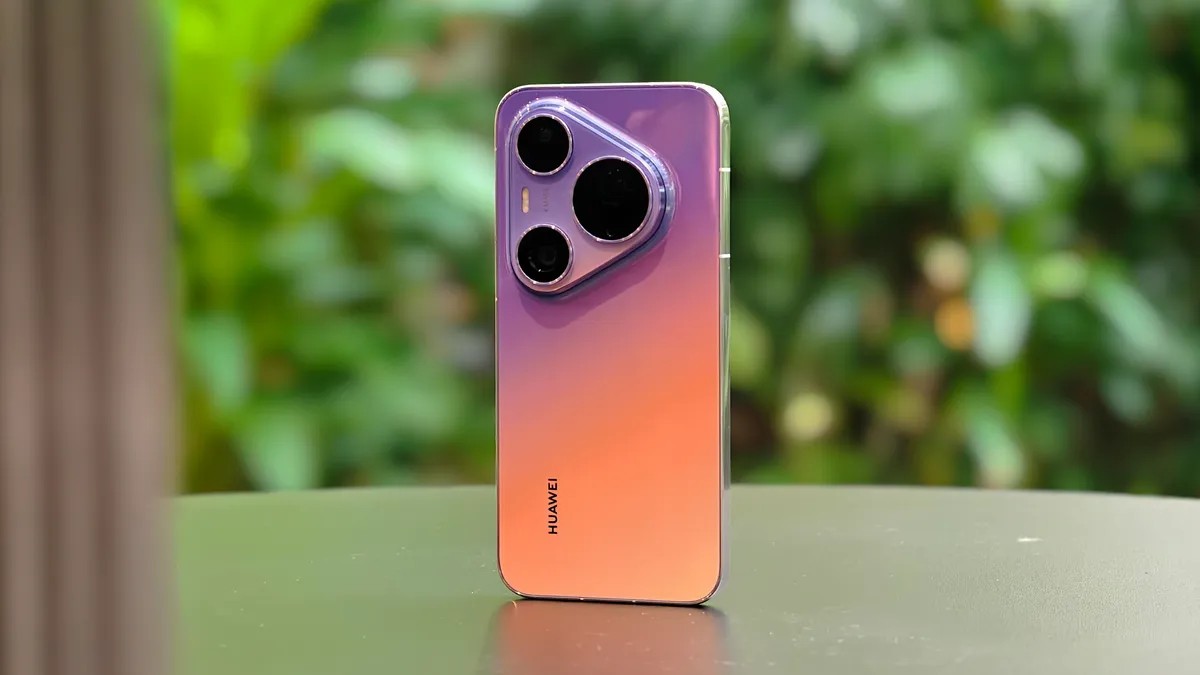
The design hits you first. Two-tone gradient on the back.
I spent a day with the “orange ocean” variant. It’s purple fading into orange. Bold. Maybe too bold for some. There’s also sunset purple and emerald lake if you prefer something less aggressive. Or just stick to the solid colors: dawn gold and obsidian black.
It reminds me of the P30 Pro. The aura, the light bending in the plastic or glass, the way it catches the eye. But while that older model had curvy sides, this new Pro Max has a flat frame.
I hate flat frames on heavy phones. I missed the curves of the Ultra variant. The Pro Max weighs 230.5g. Compare that to the iPhone 17 Pro max at 233g or the Pixel 10 Pro xl at 232g. It’s heavy. It feels dense.
Fortunately, it’s not uncomfortable. You can hold it one-handed. It’s slippery enough but grippy enough. It’s rated IP68 and even IP69. So yes, it survives drops. Yes, it survives pressure washing. You’d think they’d put that weight towards curving the edges a bit.
Up front, a 6.9-inch OLED screen. The bezels are thin. There’s an anti-reflective coat on top, and it works. I walked through Bangkok in harsh sunlight. I could still see the map. I could see the viewfinder. It doesn’t wash out.
But I couldn’t install Instagram. Or Twitter. Or really anything useful from the Play Store. So while the screen looks amazing, what do you put on it? Videos mostly.
The camera stack that tries too hard
Here’s the meat of it.
This phone sits below the Ultra in Huawei’s hierarchy. Yet, the specs are stacked. A 200MP periscope? Variable aperture? New AI toys? Check, check, check.
The main shooter is 50MP. It uses Lateral Overflow Integration Capacitor tech. Fancy words for saying it handles highlights and shadows better without clipping. Then there’s the physical trick: a variable aperture from f/1.4 to f/4.0.
Think of it like your eye squinting against the sun. You close down to f/4 for bright days. Open it to f/1.5 for the dark. Most phones fake this. Huawei moves actual mechanical blades inside the lens. That’s rare. That’s cool.
Then comes the beast: the periscope zoom. It’s 200 megapixels. A massive 1/1.2-inch sensor. 4x optical zoom at a 96mm equivalent focal length. Huawei claims it keeps details intact even when the light is poor.
And yes, there’s a 40MP ultrawide to cover the bases.
I walked around with it for an hour. Here’s what I found.
- The 200MP mode is genuinely useful for architecture. You zoom in on skyscrapers later in Lightroom, and the textures are still there. No pixel soup.
- The variable aperture in Pro mode changes the look of the photo physically. Not digitally blurred. Actual depth of field.
- There’s a new color slider in the viewfinder, similar to iPhone’s Photographic Styles. It adjusts tone on the fly.
- Beauty mode is on by default. I forgot to turn it off. My skin looked plastic. I like pores.
AI that wants you to dance
Huawei added a feature called Pose Ideas. It’s supposed to suggest how to pose for photos based on where you are.
In theory? Magic. In practice? A bit of a headache.
I pointed it at my friend for lunch. The camera recognized her. It suggested seated poses. But here’s the catch: she couldn’t see the phone.
So I had to turn the screen to her. Cover the camera lens with my hand. Ask her to look. Then turn it back around. Then try to align her with the on-screen outline while she stayed still.
It’s tedious. Who has time for that in 2025?
But for selfies? It works. You trigger it, you see the pose on your screen, you copy it. Simple. I love not knowing what to do with my hands in photos. This helps. But it feels like a feature begging to exist on a foldable phone, where the outer screen could show the pose while you’re photographing someone else.
There are glitches too. Sometimes it switches to the ultrawide camera for no reason. It seems to prefer indoors lighting. It defaulted to 2x zoom when my friend was across the table, which is decent, but the execution feels unfinished.
Inside the box
Power comes from Huawei’s own Kirin 9030S chip. They claim a 200% boost in AI performance compared to the last generation.
It feels fast. Smooth scrolling. Apps opening quickly. No lags noticed in my short time with it.
The battery is a massive 6,000mAh. That should last forever. Charging is quick too: 100W wired, 80W wireless. It runs HarmonyOS 6.1, which now includes a native “agentic AI” assistant. It promises to learn your habits. Useful? Probably. Useful now? I haven’t seen it prove it yet.
You can buy this in China for about CNY 6,498, roughly $955 for the 256GB model.
The camera hardware is fascinating. The design is polarizing. The lack of Google services is still the elephant in the room, staring right at you with smoothed-out pores.