


Modem designers didn’t just get lucky with faster speeds. They had to engineer their way out of a bandwidth bottleneck. The old tricks like frequency-shift keying hit a wall. So, they switched to phase-shift keying (PSK). Then came quadrature amplitude modulation (QAM). These techniques squeezed an insane amount of data into the 3,000 hertz slice of bandwidth that a standard voice-grade phone line offers.
You might remember the 56K modem. It never actually hit 56 Kbps. In the real world, it capped out around 48 Kbps unless you had a pristine line and zero noise. That was the hard limit for those analog-era tricks.
These high-speed modems used a concept called gradual degradation. If the line was noisy or thin, the modem didn’t just fail. It tested the connection. It backed down to a slower speed. It kept the link alive.
Then came asymmetric digital subscriber line (ADSL). The name says it all. Asymmetric. It sends data faster in one direction than the other.
Why does that matter? Most home users download more than they upload. Streaming video. Loading web pages. Sending emails. ADSL exploits this behavior.
It also exploits physics. Every house or office has a dedicated copper wire running to the phone company’s central office or mux. This wire isn’t shared like a party line. It’s point-to-point. That dedicated path can carry far more data than the 3,000 hertz required for a voice call.
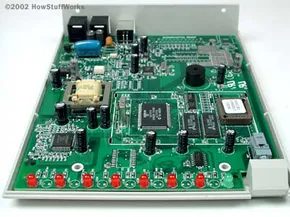
If your house has an ADSL modem and the central office has one too, that copper section becomes a purely digital high-speed channel. The capacity under ideal conditions is roughly 8 Mbps downstream (from the internet to you) and 1 Mbps upstream. That’s a massive jump from 48 Kbps.
The same line handles both. You can talk on the phone while downloading a file. The signals don’t crash into each other.
How does it work? The approach is surprisingly simple.
The phone line’s bandwidth between 24,000 hertz and 1,100,000 hertz gets chopped up. It’s divided into 4,000-hertz bands. A virtual modem is assigned to each band.
There are about 249 of these virtual modems. Each one tests its specific slice of bandwidth. It does the best it can with what it’s allocated. Some bands are clean. Some are noisy. The noisy ones slow down. The clean ones speed up.
The total speed of your pipe is the aggregate of all 249 virtual modems working in parallel.
The capacity is something like 1 million bits per second (Mbps) between the home and the phone company (upstream) and 8 Mbps between the phone company and the home (downstream) under ideal conditions.
This architecture is why ADSL felt so much faster than dial-up. It didn’t just push harder. It changed the game. It used the whole wire, not just the low-end frequencies.
DSL technology has evolved since then. Fiber optics are now common in many areas. But the principles of splitting bandwidth into channels and managing noise remain relevant.
If you’re still on dial-up, you’re missing out. If you’re on ADSL, you’re living in the past. But understanding how we got here helps explain why modern broadband looks the way it does.
The jump from analog to digital wasn’t just technical. It was inevitable. We needed more bandwidth. The copper was there. We just had to figure out how to use it.
So, what’s next?
The copper is still there in many places


