
We usually think of an amplifier as a bulky rack of equipment or a guitar pedal, but that is just the tip of the iceberg. Amplifiers are everywhere. They are inside your television. They are in your desktop PC. They are in that portable CD player you haven’t touched in years. Any device with a speaker needs one.
Sound itself is simple physics. An object vibrates. It shoves air molecules. Those molecules shove their neighbors. The wave travels. Your ear catches the pressure change and sends an electrical message to your brain.
Electronic gear mimics this process. It turns sound into electricity and back again. The workflow is standard across almost all audio hardware:
- A microphone diaphragm moves with sound waves, creating a weak electrical signal. This signal mirrors the compressions and rarefactions of the air.
- A recording device stores that signal. Think magnetic tape or vinyl grooves.
- A playback device reads the storage medium and converts it back to electricity.
- This electricity pushes a speaker cone, recreating the original air pressure waves.
Every component here is a translator. Input becomes output. The chain is clean until you hit the final step.
The Power Problem
Microphones need to be sensitive. They must catch subtle pressure changes. That means the diaphragm is thin. It moves a tiny distance. The result? A very small electrical current.
Small signals are fine for recording. They travel easily through wires. They are easy to store. But they are useless for speakers. You cannot move a heavy speaker cone with a weak signal. You need more current. You need to boost the power without changing the shape of the wave.
This is what an amplifier does. It takes that weak signal and makes it stronger. It preserves the pattern of charge fluctuation while increasing the overall strength. The output matches the input, just louder.
To understand how it achieves this, you have to look inside the box. It is not magic. It is silicon.
The Core Component
At the heart of almost every amplifier is the transistor. These are tiny switches made from semiconductors, usually silicon. The material is modified through a process called doping. This changes how electrons move through it.
A typical transistor has a three-layer structure. It mixes p-type and n-type semiconductors. This arrangement allows it to control the flow of electrical current. The transistor creates a pathway for electric charge to flow. It manipulates zones of free electrons and holes to boost the signal.
The complexity of a modern amplifier can be overwhelming. There are hundreds of tiny pieces. Capacitors. Resistors. Inductors. But the logic is singular. You need a device that can take a small input and control a large output. The transistor is that device.
Why It Matters
Without this boost, your audio system is dead in the water. A microphone picks up sound. The signal travels to a recorder. The recorder stores it. But if you try to play that stored signal directly to a speaker, you hear nothing. Or perhaps a faint whisper. The energy is insufficient to move the cone.
The amplifier solves this by acting as a valve. A small current controls a larger current. The pattern remains the same. The volume changes. This is why your stereo system can fill a room. This is why your phone can project sound clearly.
The science is straightforward. The implementation varies. But the goal is always the same. Take a weak signal. Make it strong. Keep it true.
We will dive deeper into the specific types of transistors and how they are arranged in circuits. But the basic principle holds. You are using electricity to control electricity.

How Amplifiers Actually Work
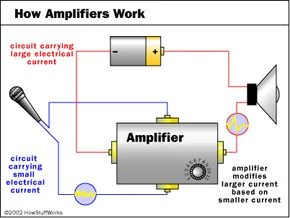
Most people think an amplifier just turns up the volume. It’s a simple logic: weak signal goes in, loud signal comes out. But inside the chassis, the reality is far more complex. The truth is that the amplifier doesn’t actually amplify the input signal. It uses the input as a blueprint to generate a completely new output signal.
Think of this as two separate electrical worlds colliding.
The output circuit is where the heavy lifting happens. It’s powered entirely by the amplifier’s power supply, drawing energy from a wall outlet or battery. If you’re plugged into a standard household outlet, you’re dealing with alternating current (AC). The current is constantly changing direction. The power supply rectifies this, converting it into direct current (DC). It also smoothes out the electrical flow. The result is an even, uninterrupted stream of energy. This energy moves the speaker cone, which is the actual load of the system.
The input circuit is a different beast. This is the raw audio signal. It might be coming from a microphone or a tape deck. Its job isn’t to power the speaker directly. Its job is to modify the output circuit. It does this by applying varying resistance. The input signal tells the power supply exactly how to shape that smooth DC current to match the voltage fluctuations of the original sound.
Here is the problem. That raw input signal is weak. It doesn’t have the muscle to control the output circuit effectively. The load is simply too heavy.
This is why you need a pre-amplifier.
The pre-amp takes that feeble input signal and boosts it. It sends a stronger, more manageable signal to the power amplifier. The power amp then uses this boosted command to shape the massive output. Some systems stack multiple pre-amplifiers to gradually build up to the high-voltage output required for big speakers.
The input signal doesn’t drive the speakers. It guides the power supply.
So how does any of this happen? If you crack open an amplifier, you won’t find a single magic transistor. You’ll see a dense, complex mass of wires and components. This isn’t over-engineering for the sake of it. This elaborate setup ensures precision.
Hi-fidelity isn’t about just making noise. It’s about accurate reproduction. Every nuance of the original recording needs to be represented correctly. The circuitry exists to maintain that control. Without it, you don’t get clarity. You just get volume.
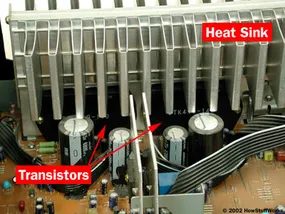

You don’t need to dissect every single piece of an amplifier to grasp the basics. Most of the hardware is just support staff. A handful of components do the heavy lifting. We are going to strip away the noise and look at the minimal viable design. This is how a signal gets from point A to point B with more volume.
The Heart: Transistors and Tubes
At the core of any amplifier is the active device. It acts as a valve. It controls the flow of electrical current.
In modern gear, you will mostly see transistors. These are solid-state devices. They are small, cheap, and durable. They amplify the signal by using a small input current to control a larger output current. Think of it like a faucet. A tiny turn of the knob (input) lets a massive amount of water (output) flow through.
Vintage enthusiasts might argue for vacuum tubes. These are the older technology. They require heat. They consume more power. But many people prefer the “warmth” of tube distortion. The physics are different. Tubes rely on heated cathodes emitting electrons. Transistors rely on semiconductor physics. Both achieve the same end result: making the signal bigger.
The Power Source
An amplifier needs energy. You cannot get something for nothing. The power supply provides the raw DC voltage. This energy is what gets modulated by your signal.
When you plug your guitar or instrument into the amp, you are sending a weak signal into the circuit. That signal tells the active device how to shape the incoming power from the supply. Without a robust power supply, the amplifier clips prematurely. The sound gets muddy. You lose dynamics.
A weak power supply limits your headroom. Strong power supplies allow for cleaner volume before distortion hits.
The Input Stage
Your signal enters here. It is usually very faint. A guitar pickup might only output a few millivolts. This is not enough to move air in a speaker cone.
The input stage has two jobs. First, it matches the impedance. If the input impedance is too low, it drains the signal from your instrument. The tone becomes dull. Second, it provides initial gain. It boosts the signal to a level the next stage can handle.
This is where input impedance matters most. A high input impedance (usually around 1 megaohm) is ideal. It ensures you don’t load down your pickups. If you are using a passive pickup, this is critical. Active pickups are less sensitive, but high impedance still preserves the high-end frequencies.
Coupling and Gain Stages
Once the signal is boosted, it moves through coupling capacitors. These components block DC voltage while allowing the AC audio signal to pass. This protects your speakers from DC damage. It also isolates the bias points of each amplifier stage.
Between stages, you have gain. Each stage adds volume. But it also adds noise. And if you push it too hard, you get distortion. This is often called “overdrive” or “clipping.”
- Preamp stages shape the tone. They add the character.
- Power amp stages deliver the muscle.
In a basic design, you might just have one gain stage. In a complex hi-fi system, you might have dozens. Each

The component at the heart of most amplifiers is the transistor. It’s the workhorse.
Semiconductors make up the main elements. These materials conduct electricity, but not very well unless you tweak them. Usually, you start with a poor conductor like silicon. Then you add impurities. This process is called doping.
Pure silicon is orderly. Atoms bond perfectly. No free electrons. No current flows. Doping breaks that order. It adds atoms that either release free electrons or create holes where electrons can sit. Charge moves by filling these holes. More holes or more electrons mean better conductivity.
There are two main types. N-type semiconductors have extra electrons. Negative charge. P-type semiconductors have extra holes. Positive charge.
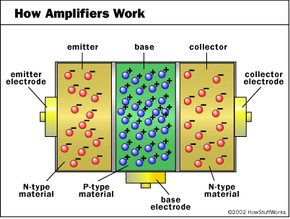
Let’s look at an amplifier built around a basic bipolar-junction transistor. This structure has three layers. A p-type layer sits between two n-type layers. Think of it as a sandwich.


The first n-type layer is the emitter. The middle p-type layer is the base. The second n-type layer is the collector.
The output circuit connects to the emitter and collector. This is what drives the speaker. The input circuit connects to the emitter and base.
Free electrons in the n-type layers want to fill the holes in the p-type layer. There are way more electrons than holes. So the holes fill up fast.
This creates depletion zones at the boundaries. The material reverts to an insulating state. All holes are filled. No free electrons. No empty spaces. Charge can’t flow.
When depletion zones are thick, current barely moves from emitter to collector. Even with a strong voltage difference.
Boosting the Voltage
You can fix this by boosting the voltage on the base electrode.
The base voltage is controlled by the input current. When input current flows, the base becomes relatively positive. It draws electrons from the emitter.
This frees up holes. Depletion zones shrink.
Now charge can move easily from emitter to collector. The transistor becomes more conductive.
Conductivity depends on base voltage. Fluctuating input current at the base varies output current at the collector. The speaker gets the signal.
One transistor is one “stage.” Amplifiers usually have several stages. The final stage drives the speaker.
Small amps, like in a speakerphone, might output half a watt. Home stereo amps do hundreds of watts. Concert systems push thousands of watts.
The goal is low distortion. The output should mimic the input. Even after boosting.
This works for more than audio. Radio signals. Video signals. Anything carried by electrical current.
Audio amps get the most attention. Enthusiasts care about power rating, impedance, and fidelity. These specs matter.
Frequently Asked Questions
Can you use amplifiers with any type of speaker?
You can use most, but compatibility depends on amplifier power output vs. speaker power handling. Mismatch can damage equipment.
How does amplifier wattage affect sound quality?
Higher wattage allows higher volume without distortion. This improves sound quality at loud volumes.