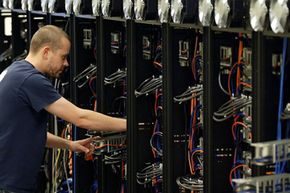
Most people imagine supercomputers as sci-fi machines that can leap tall buildings or secretly protect innocent bystanders. That’s not how it works. The reality is far more mundane, yet just as impressive. Supercomputers are simply machines designed to crush complex calculations with terrifying speed.
If you want to understand what makes them “super,” you have to look at the math. Everything a computer does, from opening a browser tab to rendering a 3D video game, breaks down into arithmetic. Your processor interprets every command you click as a series of math problems. A faster processor handles more of these problems per second. It also handles the harder ones better.
The secret sauce is the electronic clock inside your CPU. This clock generates a steady stream of electrical pulses at regular intervals. Think of it as the conductor of an orchestra. It synchronizes all the components so they don’t trip over each other. It also dictates how fast the computer can pull data from memory and crunch numbers.
When you brag about your processor having a 3.2 gigahertz clock speed, you’re describing that pulse rate. Specifically, 3.2 gigahertz means the CPU sends out roughly 3.2 billion electrical pulses every single second. You can push some processors beyond their advertised limits through overclocking, but there is a hard ceiling. Eventually, the clock hits its physical limit and stops going faster.
Measuring performance gets more specific with floating-point operations per second, or flops. This metric tracks how many complex decimal calculations a machine can handle. Current desktop CPUs operate in the gigaflops range. But if you want raw power, you need multiple cores. Each core in a multi-processor system handles its own slice of calculations. Adding cores boosts total computing power while actually using less electricity than a single, overstressed core.
“A faster processor can handle more calculations per second than slower ones, and they’re also better at handling really tough calculations.”
Speed isn’t everything. Some tasks are just inherently difficult. Take finding the prime factors of a massive number. It sounds easy. It isn’t. A standard computer has to find the factors first. Then it has to verify if those factors are actually prime. For incredibly large numbers, this process is laborious. It can take a high-end machine years to finish the job.
This is where the future shifts gears. A fully functional quantum computer wouldn’t just be faster; it would work differently. It could calculate those factors in parallel. Instead of years, it might provide the most likely answer in moments. Quantum computing has its own set of challenges and won’t replace your laptop for browsing the web. But it reshapes our entire understanding of what computing power means.
The State of Processing Power
As of March 2010, the crown for raw processing power belonged to the Jaguar supercomputer. Built by Cray as a XT5 model, it sat at the top of the food chain. The Jaguar could process up to 2.3 quadrillion calculations per second. That number is hard to visualize. It’s essentially a machine that thinks billions of times faster than your home PC.
Computing power in AI relies on similar principles. It determines how effectively a computer performs specific tasks and how accurately it predicts outcomes. The more flops and the better the architecture, the smarter the machine appears.
Frequently Asked Questions
What is computing power in AI?
In artificial intelligence, computing power dictates how well a system performs a task. It influences the accuracy of predictions and the speed of training models. More processing capability means faster, more precise outcomes.
How does clock speed affect performance?
Clock speed, measured in gigahertz, determines how many electrical pulses the CPU sends per second. Higher speeds mean more instructions processed per unit of time. However, it isn’t the only factor. Core count and architecture matter just as much.
What is a floating-point operation?
A floating-point operation (FLOP) is a calculation involving decimal numbers. It’s the standard metric for measuring high-performance computing. Supercomputers track their power in teraflops or petaflops (quadrillions of operations per second).