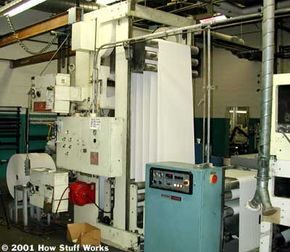
The backbone of many publications such as How Stuff Works Express is web offset lithography. This is not the time-consuming printing method you might expect from a small print shop. Here, the machine does not stop to stop for paper. Consumes a continuous flow fed by large rollers weighing up to 2,000 lbs.
Speed is the most important metric. These presses work at incredible speeds and produce up to 50,000 impressions per hour. An impression covers a large sheet of paper (38 inches by 22.75 inches) corresponding to 12 pages of the final magazine. By the time the paper exits, it’s trimmed to size.
Splicing Without Stopping
It is commonly believed that the printing press stops when the paper roll runs dry. This never happens in web offset printing. This system uses a mechanism called “festoons” to splice new rolls onto the existing web while the machine is running at full speed.
This process is mechanical and precise.
- Tower : a festoon is a series of rollers arranged in a vertical tower.
- The Buffer : Just before the current roll is depleted, the festoon rises to the tower. This action pulls the paper in and creating slack.
- Splicing : The rotating rolls pause for a split second. The tape connects the end of the empty roll and the beginning of the new roll.
- Release : When the speed of the new roll increases, the festoon will fall from the tower. The descent speed is synchronized with the press speed.
The user does not touch any controls during this transition. The machine automatically controls tension and splicing.
Balancing Tension
In order for the web to print clearly, it must remain firmly flat as it passes through a complex set of rollers and cylinders. The press maintains a delicate equilibrium. You have to balance the forward force that pulls the paper and the back pressure that opposes its movement. Too much pull and the paper snaps or distorts. Too little, and it wrinkles.
The Chemistry of Ink and Water
The “offset” part of lithography is based on the fundamental chemical rule that ink and water do not mix. This principle dictates how the image is transferred.
The ink is applied to the printing plate through a series of rollers. First, the plates are dampened with water. Next, the ink roller applies the ink. Due to the chemical repulsion between oil-based ink and water, the ink only adheres to the image areas of the plate, not the non-image areas that the water keeps moist. This will ensure that your design is transferred clearly and distinctly.
What Happens Next
The physical movement of the paper is only half the battle. The actual transfer of the image depends on the offset mechanism. The next section looks at how the printing plate transfers the image to the blanket and then onto the paper.