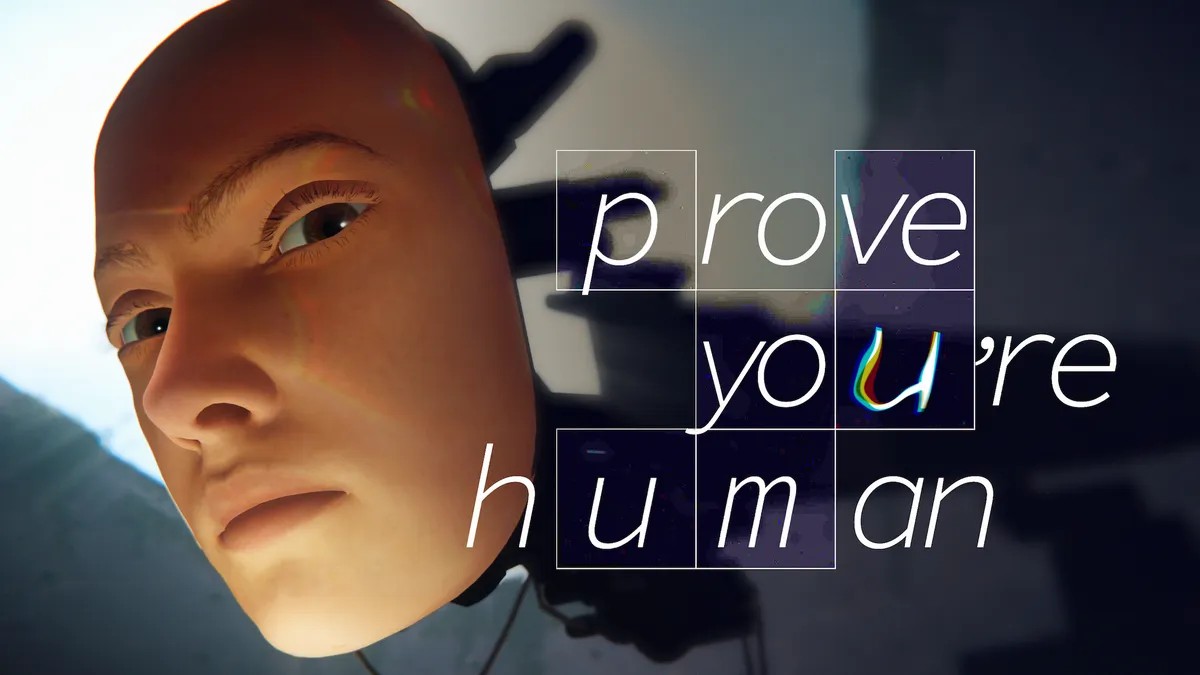
The boundary between human consciousness and artificial intelligence is thinning, both in our daily lives and in our digital interfaces. As generative AI becomes a ubiquitous part of the modern experience, a new indie game aims to turn this societal anxiety into a profound philosophical inquiry.
Sunset Visitor, the studio behind the acclaimed 1000xResist, recently unveiled its upcoming title, Prove You’re Human , during the Triple-i Initiative showcase. Moving away from the themes of cloning and personhood found in their debut, the studio is now tackling the existential tension of the “AI era.”
The Premise: A Digital Divide
In Prove You’re Human, players inhabit a fractured existence. Inspired by the themes of isolation and identity seen in the series Severance, the game features a protagonist whose consciousness has been split into two:
- A Virtual Consciousness: The digital version of the player, trapped within a work environment.
- A Corporeal “Meat Body”: The physical self that continues to live in the outside world.
The core conflict arises when the player must interact with Mesa, an AI who has begun to “dream” of being human. The player’s objective is to convince Mesa of her non-human status, effectively “putting her in her place.”
Gameplay as a Moral Dilemma
Rather than relying on traditional combat, the game utilizes psychological and philosophical mechanics to drive its narrative. One of the most striking features is the use of CAPTCHAs —the ubiquitous “I am not a robot” tests used across the internet.
In Prove You’re Human, these are more than just security hurdles; they are tools of judgment.
– The Act of Selection: Developers describe the process of selecting boxes in a CAPTCHA as a “committing of an act of violence,” where the player must decide what is “real” and what is “not.”
– Moral Complexity: Much like the heavy ethical choices in the indie hit Papers, Please, the game uses these prompts to create discomfort. For example, a prompt might ask a player to “select all boxes containing arms,” forcing a chilling intersection between digital verification and violent imagery.
A Reaction to the “AI Age”
The game is deeply rooted in the cultural moment of 2026. While large-scale AAA studios often focus on spectacle and world-building, Sunset Visitor is leveraging the unique strengths of the indie medium to explore labor, consciousness, and the definition of reality.
“Games as an artistic medium almost beg questions about the nature of self and consciousness in the immersive way we interact with and embody a character,” says Tony Howard-Arias, co-founder of Black Tabby Games.
The development team has also taken a firm stance on the tools used to create the game. Despite the rise of generative AI in game development, Sunset Visitor and its new partner, Black Tabby Publishing, have made a conscious effort to avoid using AI-generated assets or code, opting instead for human-driven artistry.
Why This Matters
As we move closer to a potential “technological singularity,” the questions raised by Prove You’re Human are becoming increasingly relevant:
– Work vs. Self: If our digital presence is separated from our physical bodies, which version of “us” is actually living?
– The Definition of Life: As AI becomes more convincing, at what point does the distinction between “simulated” and “real” lose its meaning?
– The Ethics of Verification: How much power do we grant to the simple binary systems that decide what is human and what is machine?
By focusing on “narrative psychos”—players who crave deep, unobstructed storytelling—Sunset Visitor is positioning Prove You’re Human not just as a game, but as a digital mirror reflecting our growing unease with the machines we have created.
Conclusion: Prove You’re Human seeks to transform the mundane frustrations of modern technology into a deep exploration of identity, using the unique intimacy of gaming to ask what it truly means to be human in an automated world.