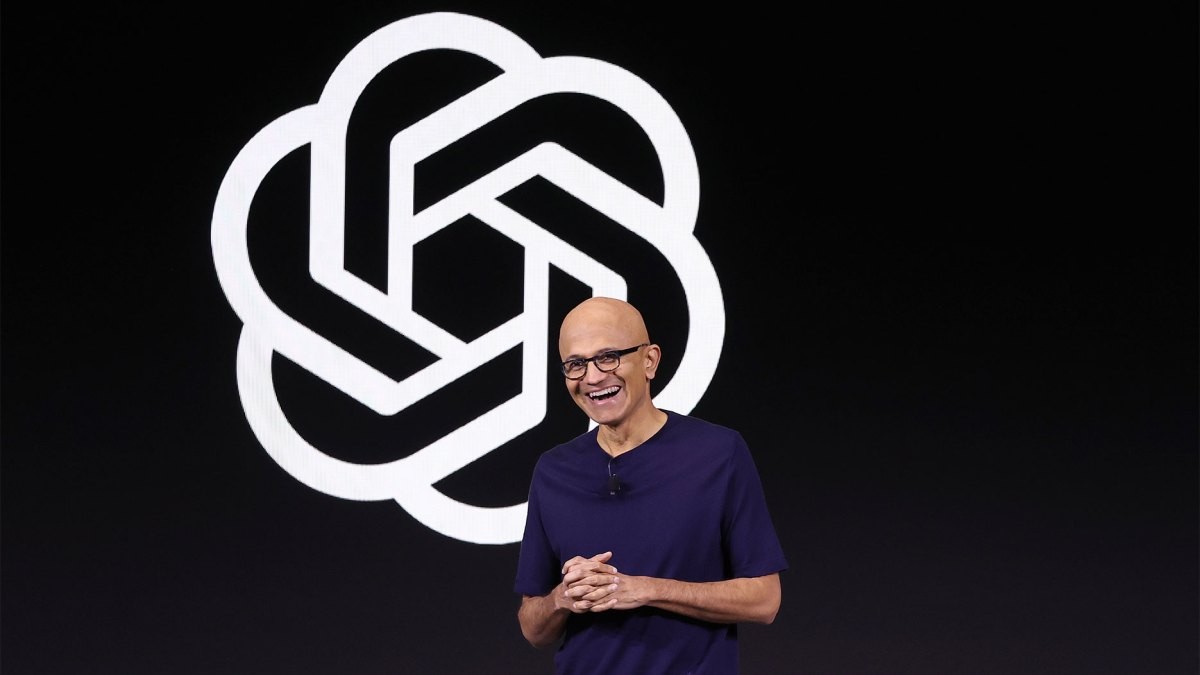
Satya Nadella didn’t mince words on CNN’s “Fareed Zakaria GPS.”
The Microsoft CEO went on the record warning companies that they will not survive if they trust a single AI provider for everything. He didn’t say “might struggle.” He said “won’t survive.”
The premise is simple but brutal: if you outsource your thinking to a proprietary lab, you cease to be a viable business in the long run.
The Danger of Outsourced Intelligence
Nadella’s argument centers on data retention. Specifically, how metadata is handled when prompts hit a model.
He told Zakaria that businesses need to hoard every scrap of data generated during model usage. Not because they are paranoid. Because that metadata is raw material for training future iterations of your own weights.
“Every time you use the model, all of this metadata around it is retained by you,” Nadella said. “You could use all of that to train… your own weights or your own open models.”
If a company hands over its proprietary prompts without keeping the surrounding context and usage logs, it is effectively surrendering its competitive edge. You lose the feedback loop required to refine your own intellectual property.
Any firm without this control, Nadella claims, has outsourced its core intelligence. And you can’t compete if someone else holds the keys to your brain.
Why AI Gateways and Model Diversity Matter
This is where the infrastructure layer comes in.
Nadella is pushing for an architecture that separates the harness from the model.
For those not deep in the code, the harness includes coding agents and interface tools like Anthropic’s Claude Code or OpenAI’s ChatGPT Code Interpreter. These are popular. They are profitable for labs. They are exactly what Nadella is advising enterprises to decouple from the base model.
Keep the context separate from the model.
This allows a company to build an AI gateway—a layer of middleware that sits between your internal systems and various AI endpoints. The benefits are threefold:
- Vendor Lock-in Prevention: You can swap out underlying models if prices rise or quality drops.
- Best-of-Breed Strategy: Use different models for different tasks. One for code generation. Another for nuanced analysis.
- Data Sovereignty: Your proprietary data never truly leaves your control architecture; it just gets routed.
At the same time, any single model can vanish. Or change its pricing. Or shut down. You remain in control of your own destiny.
The Microsoft Self-Serving Angle
Let’s be honest about the subtext.
Microsoft is heavily invested in both Anthropic and OpenAI. Yet, Nadella is publicly advocating against deep reliance on them.
Why? Because Microsoft is pivoting its cloud business to sell the exact infrastructure he’s describing.
If enterprises adopt AI gateways and move away from direct API calls to single models, Microsoft is positioned to sell the middleware that makes it all possible. It’s a self-serving warning, sure. It’s fear tactics packaged as strategic advice.
But he’s not wrong.
Why Open-Weight Models Are the Real Answer
Enterprises are waking up to the cost of proprietary black boxes.
Runaway budgets are one factor. Cheaper alternatives are another. This has triggered a migration toward open-weight models. These are models with publicly available code that companies can fine-tune and run on their own hardware.
This shift requires management.
You can’t just plug and play with twenty different open-source models running on private servers without a robust gateway system. The complexity demands a middle layer. And that is the market Microsoft is targeting.
The Existential Threat of Model Competition
The risk goes beyond costs.
It’s about existential survival.
If you feed a massive AI lab your data, your workflows, and your operational secrets through an AI agent, you are teaching them how to run your business better than you can.
Once a company has outsourced its thinking, there is no legal or technical barrier stopping the AI lab from launching a competing service. They have your data. They know your pain points. They have the compute power.
It’s the classic platform playbook: copy the innovation and bury the creator.
Jason Calacanis, a prominent seed investor, warned Y Combinator founders about this exact dynamic back in May. He told startups not to accept OpenAI’s investment credits because doing so gives the tech giant a roadmap to copy their ideas.
“If you take these tokens… there’s a non-zero chance that Open AI will study exactly what your startup is doing and copy your idea.”
Now Nadella is screaming the same warning to large enterprises.
It’s a valid fear. The startup industry has been shuddering over this for years. When the platform is the product, you are building your competitor’s moat.
What About Everyday Users?
Nadella made one important distinction.
His warnings apply strictly to businesses. Not individuals.
When Zakaria asked how ordinary people could protect themselves, Nadella essentially shrugged.
The value exchange is clear. Consumers get free services; in return, they give their data. That’s how the advertising business model works. That’s how it has always worked.
If you want free tools, you are the product. There’s no gateway layer for a teenager using a chatbot. There’s just a terms of service agreement they scroll past and click “Agree” on.
Businesses, however, are not consumers. They hold assets. They have processes. They have market positioning.
If they treat their data like consumer data—cheap and freely given away—they will disappear.
The future belongs to those who keep their keys. Who build their own gates. Who refuse to let a single lab own their collective mind.
Survival isn’t guaranteed for anyone. But it’s certainly not guaranteed for those who outsource their brains.