The evolution of #transistors: from Bell Labs to molecular computing
In the 1960s and 1970s, electronics relied on junction transistors. Bell Labs provided us with this design, and it remained standard for a long time. After that, the development of silicon made great progress in the 1970s. Introducing metal-oxide-semiconductor field-effect transistors (MOSFETs). MOSFETs use the same basic principle, but change the placement of the silicon. N-type silicon and P-type silicon are doped with various metals and oxides. result? The materials are cheaper. Better layout. Give engineers more flexibility.
The engineers didn’t stop there. They started classifying transistors by everything from semiconductor material to power ratings. Why? This is because each application requires different functions. Operating frequency is important. Structure is important. Then came a big leap into manufacturing. Engineers realized that they could manufacture thousands of transistors simultaneously on a single sheet of semiconductor material. Adding the capacitor and resistor completes the integrated circuit.
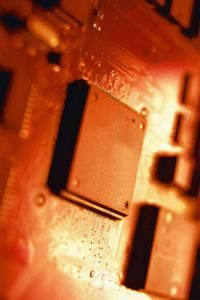
We call them chips. But inside these little boxes are billions of tiny transistors.
Since the 1960s, the density of transistors has doubled every 1.5 years. Engineers continue to pack devices into smaller spaces. Today, commercially available silicon transistors are less than 45 nanometers. To put that in perspective, NVIDIA’s GF100 graphics card architecture has over 3 billion transistors. This is the most compact chip ever.
But these modern transistors look big compared to future transistors.
Researchers from Yale University and South Korea have built the world’s first molecular transistor. Made from a single molecule of benzene. Size isn’t the only win here. The efficiency is real. Current chips waste a lot of energy in the form of heat because they do not deliver energy fully efficiently. Molecular transistors have the potential to solve this problem. These can significantly improve the energy efficiency of future devices.
Materials also change. Graphene is becoming a serious contender. Transports electrons much faster than silicon. According to some estimates, graphene-based processors could run up to 1,000 times faster than current silicon products.
軌道は明確です。 トランジスタは今後も研究を推進していきます。 コンピュータはより高速になります。 もっと安い。 より信頼性が高くなります。 携帯電話や音楽プレーヤーは、コストを下げながら超小型サイズに縮小されるでしょう。 この変化の全範囲を想像するのは困難です。 しかし、それはこの単純な装置から始まります。 60年以上前に発明されました。
トランジスタの力はハードウェアを超えて広がります。 重要なのは、それがテクノロジーの状況をどのように変えるかです。 結局のところ、私たちの社会です。 これほど小さなコンポーネントではかなりの重量になります。
The story of today’s digital world does not start with smartphones or cloud servers. It started in 1954 with the crackling of a small plastic box.
Texas Instruments does more than just make radios. They supplied the transistors that made it possible. Until then, electronic devices were large, hot and fragile. Vacuum tubes dominated radio waves. They needed high voltage. They burned out. Regency TR-1 changed the physical properties of personal media. This was the first commercially manufactured transistor product. You can slip it into your pocket. No more carrying around a cabinet receiver.
This isn’t just a new gadget. This is a hardware revolution.
Why transistors are more important than radios
Consider the size difference. Heavy duty vacuum tube radio. The Regency weighed less than 1 pound. Weight loss is no accident. This was a direct result of the transition from vacuum tubes to solid-state silicon.
How does a transistor work? It acts as a switch. Or an amplifier. It uses semiconductors to control current. This is the core of all modern computing. When you tap the screen, electricity flows through billions of tiny transistors. They interpret your touch. Render the image. It all goes back to the 1954 breakthrough.
The Regency TR-1 is a proof of concept. Texas Instruments proved the supply chain. This partnership is a testament to the semiconductor industry. It shifted investment. The focus changes. Suddenly, everyone wanted to be smaller. Faster. A cooler operating device.
魔法の背後にある物理学
これがなぜそれほど重要なのかを理解するには、科学を調べる必要があります。 半導体は導体と絶縁体の間に位置します。 ここではシリコンが王様です。
バージニア大学の仮想研究所の研究によると、これらの材料の挙動は原子構造に依存します。 シリコンに他の元素をドーピングすると、電子の流れを許可または遮断する領域が作成されます。 これがトランジスタの基本的な仕組みです。 シンプルさの中にエレガントさがあります。 その実装は複雑です。
リージェンシーは当初ゲルマニウムトランジスタを使用していました。 その後、シリコンが引き継ぎました。 シリコンはさらに豊富に含まれています。 より高い温度にも対応できます。 より安定しています。 この材料科学の変化により、今日私たちが当然と思っている小型化が可能になりました。 あなたのラップトップにはこれらのスイッチが何十億も搭載されています。 それらはナノ秒以内に発射されます。
Pushing boundaries: single molecule transistors
This trend has not stopped yet. It just keeps getting smaller.
By the end of 2009, researchers had achieved something that seemed like something out of science fiction. They created a single molecule transistor. This is not bulk material. This was one molecule acting as the active component.
UPI reported on this development in December 2009. The impact is staggering. If transistors can be shrunk down to the size of a single molecule, where does the shrinking end? It challenges the physical limits of Moore’s Law. It predicts a future where circuits are built atom by atom.
It’s not just about making things smaller. It’s all about efficiency. Less heat. Lower power consumption. Faster. The path from Regency TR-1 to a single molecule switch is a straight line of continuous optimization