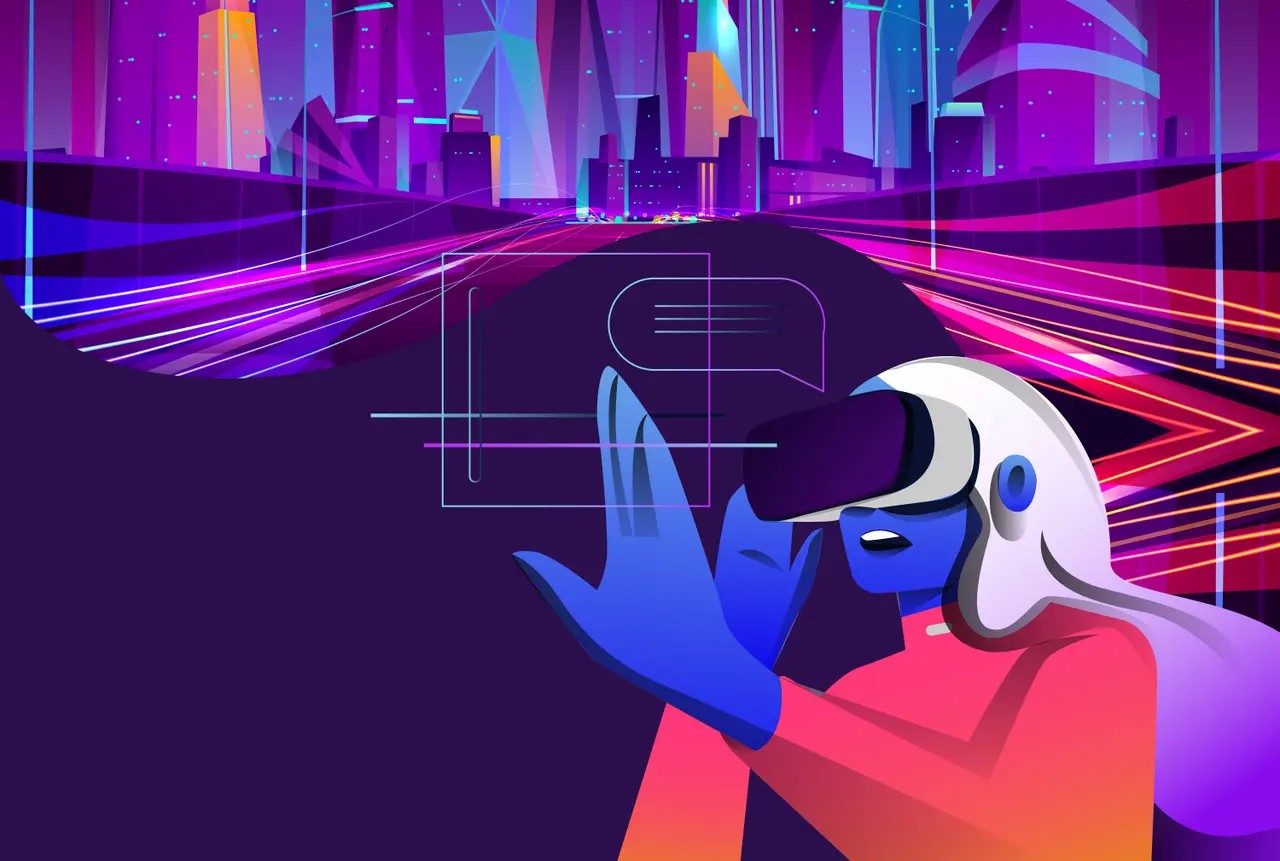
We’re chasing the Internet’s new holy grail. It’s a parallel world to ours, a place where you can interact, socialize, play and work just like in real life. This is the metaverse. In French it is called “le métavers”.
Mark Zuckerberg and others are passionate about building it. But what exactly is it?
Etymologically, this word says it all. “Meta” means transcendence. “Vers” represents the universe. In other words, beyond the universe. parallel reality.
Where did this concept come from?
The term didn’t just appear out of nowhere in a boardroom. It starts with a novel.
Neil Stephenson created the “metaverse” in his 1992 novel Snow Crash. This book imagines citizens exploring the online world through digital avatars. For them it is an escape. The world economy has collapsed. Governments have lost their power over large corporations. The Metaverse is a safe haven.
The main character’s hero lives there. He can access it through glasses and headphones.
Steven Spielberg later took on a similar vibe in Ready Player One (2018). There is an oasis. A virtual world where the main character jumps. But the parallel universe here is mainly for gaming. Not for life.
Then there are cryptocurrencies. Non-fungible tokens (NFTs) is a game changer.
Suddenly, online gaming looks like a virtual world. Titles like “The Sandbox” and “Decentraland” appeared. These facilities allow you to keep the land to yourself. you interact with it. It changes your appearance. You own the digital domain.
Facebook invests in new social dimensions
The concept took to the main stage at the end of October 2021.
Facebook announced that it is building this parallel world. To confirm its intentions, the company changed its name to Meta. They wanted to demonstrate their goal of creating a social future for the Internet.
Zuckerberg articulated this vision.
Get together with friends and family to work, study, play, shop, create and do almost anything you can imagine.
He clearly stood out from Stephenson’s darker vision in Snow Crash
“In this book, the environment is very negative. I don’t think anything like that will happen…”
For Zuckerberg, Metaverse is a natural evolution of Facebook. The goal remains the same. It’s about connecting people.
Think of it as a social network on another level. You go through it. You bump into people. you interact. You can also play ping-pong. It’s not about escaping a collapsing economy, it’s about expanding our digital lives.
How realistic does this feel? who controls the land? These are questions in code.
For the Metaverse to feel real and important enough, three specific conditions must exist. If you ignore these, you will only see chat rooms with 360 backgrounds.
1. Full immersion
Mark Zuckerberg does not mince words. Users need to “feel” the immersion. When you enter this universe, the reality you perceive, see, sound and even touch belongs to the virtual universe instead of the physical world.
Think of virtual reality extended to a global level. Virtual reality (VR) is based on environments created by computers. Remember Indiana Jones and the Eye of the Temple? Equip Oculus Rift, HTC Vive or Valve Index. Suddenly you’re not in the living room anymore. You are navigating a temple full of traps. Graphics define your reality.
In a truly virtual universe, this transcendence of sensation is continuous. You aren’t just watching; you are interacting. You touch things. You feel them. The boundaries between digital and physical disappear when the digital side takes precedence comes to the fore.
2. Open and permanent world
Access must be immediate and continuous. Anyone can join, anyone can leave, and there are no loading screens or login delays.
Once inside, you can control it with your avatar. This doesn’t have to be a pixelated version of yourself. It can be an artificial construct that is completely separate from your physical identity. Through this Avatar, you can participate in everything that defines modern life: competitions, training modules and, of course, real work.
The key here is persistence. The world doesn’t stop when you log out. It keeps spinning.
3. Durable and ownable elements
This is where economics comes into play. your home. Your street. Your favorite corner of the virtual community. These are not temporary textures that disappear when the server is restarted.
Ownership is very important. Non-fungible tokens (NFTs) solve the problem of scarcity and uniqueness. You can display unique works of art on your virtual walls. You can own certain vehicles. You can have armor sets that are actually only in your inventory. This creates tangible value.
Preprogrammed characters can also have social roles. Think of them as NPC kiosks or support staff. These offer a similar structure to brick-and-mortar store kiosks.
“You touch things. You feel it. The boundary between digital and physical disappears.”
The meaning is simple. If the world was permanent, immersive, and you could own things in it, it wouldn’t be a game anymore. It will be a parallel society. The difference between a VR demo and a metaverse is time. One is the session. The other is a life.
Does this make it safer or just addictive? The tech doesn’t care. Just build.
Hardware required to access Metaverse
Engagement is more than just logging in. We need a new ecosystem for buying real life gear and virtual assets. You can’t just follow the crowd. Requires hardware.
First up are the headsets. That “presence” is something that everyone talks about and is non-negotiable. Oculus (owned by Meta), Sony and HTC dominate this space. However, the current boxes are big. I want light glasses. Snap-on. Instant immersion. There is a lot of speculation about neural connections, but don’t hold your breath. Most people do not use a brain-computer interface unless they do so voluntarily. And that’s unlikely to happen for a long time.
Then there is the touch gap. We have vision. We have sound. We lack touch. High-resolution tactile sensors are the next step. We need to recreate the sense of touch. Or it can be a full body suit that conveys sensations between major muscle groups. Until then, everything feels weightless and fake.
Personalization is a gold mine. Luxury brands are already moving to NFTs. Platforms like Exclusible allow jewelers, fashion designers and beauty brands to mint non-fungible tokens. Your digital skin becomes an asset to your brand.
Then there’s the economy. Requires parallel currency. Cryptocurrencies like The Sandbox and Axie Infinity are gateways. Earn money, spend money and flip. The “play to earn” model is not a scam. This is a structural change. Players are becoming shareholders.
Who actually builds it?
The meta started the hype cycle, but they weren’t alone. See who else is investing their money.
Epic Games. Creator of Fortnite. They raised $1 billion in April 2021. What’s the plan? Turn your game into a permanent metaverse. This isn’t just Battle Royale anymore. It’s a foundation.
Roblox. Another giant. They want to create real social structures in the digital space. Think less about shooting and more about being.
OVR. A global platform to buy land. build a building. Organize an event. Property taxes are a blank canvas.
Magic Leap. Startup building augmented reality infrastructure. They hired Neal Stephenson as their chief visionary. Be careful if Neal Stephenson is involved. He wrote “Snow Crash”. This is the book that coined the word.
Microsoft. They’re adapting Teams. Not suitable for gamers. For business. A metaverse for meetings. For work. For spreadsheets in 3D space.
Disney. Announced their entry in November 2021. No technical details. Just “we’re coming”. Enough to warn competitors.
Technological gaps and Ethical Void
Visionaries always point to the distant future. Why? This is because the technology is not yet perfect. This is a convergence problem.
Requires hardware. Touch is required. However, it also requires bandwidth. Fiber optics. 5G. Maybe even 6G later. Without a fast, low-latency connection, the experience lags. A delay breaks the embedding. No immersion means no metaverse.
But let’s take a step back from the technical details. Let’s talk about where this leads.
What would we get if the metaverse were embrace the metaverse?
Is this a artificial paradise? An escape from broken real world?
Or a tool for liberation? Personal freedom from physical limitations?
There are also environmental costs. The computing power required to render these worlds is enormous. Energy consumption is real.
What about political risk? We have to ask if authoritarian regimes will allow this. A space where everyone can act and speak freely? This is a hard sell for dictators.
The infrastructure is under construction. Money flows. But the destination is still up in the air. It is not entirely clear who holds the map.